I‧Lam Arth


The Noble Tongue

Welcome to The Noble Tongue - ‘I‧Lam Arth’

Welcome to The Noble Tongue. This site is dedicated to promoting the technical study of Sindarin; the Welsh-inspired language of the late professor J.R.R. Tolkien. To further this cause I have compiled several articles, a few of which are my own, for presentation here. Much of the material on this site is necessarily theoretical but hopefully will be of use to scholars of one of Tolkien's most beloved languages. May the tongues of the Elves never die.

Articles

Sindarin Articles

The graphic symbols below show the type of article presented. The number of Rings displays the level of complexity of the article (from 1 to 5).

Reading NotesReading Notes: Being presentations or compilations, these articles are accessible to all readers. No knowledge regarding J.R.R. Tolkien is needed.
Analytical ArticlesAnalytical Articles: These articles provide a detailed overview of the theme they cover. However, they require some prior knowledge of the main works of J.R.R. Tolkien.
Theoretical ArticlesTheoretical Articles: A comprehensive knowledge of the works of J.R.R. Tolkien is needed to fully understand articles in this category, the subjects treated being studied in minute detail by their authors.

Vowel Affection in Sindarin and Noldorin

 Five Rings
Bertrand Bellet — August 2005
Theoretical articleVowel affection is a prominent phonological process in the morphology of J. R. R. Tolkien’s Sindarin and Noldorin. This feature appeared in the late stages of his Gnomish and remained in his series of Welsh-inspired languages ever after. Its various kinds and the terminology used to describe them are first introduced cross-linguistically, with special reference to Celtic and Germanic languages.
Read the article

Noldorin Plurals in the “Etymologies”

 Four Rings
Bertrand Bellet — March 2005
Theoretical articleAs Carl F. Hostetter and Patrick H. Wynne state in the foreword to their “Addenda and Corrigenda to the Etymologies”, “[t]he Etymologies is without question our most important source to date for the understanding of the internal history and relationships of Tolkien’s Elvish languages, as conceived and imaged by their creator during the drafting of The Lord of the Rings”.
Read the article

Imparisyllabic nouns in Sindarin

 Four Rings
Bertrand Bellet — November 2004
Theoretical articleWhile most of the Sindarin (and earlier Noldorin) nouns and adjectives make their plural only with vowel changes, there is a small class of nouns that also add a syllable. Moreover, a handful of them have two forms in the singular: a shorter and a longer on which the plural is “regularly” built by vowel changes.
Read the article

Concerning Syntax

 Four Rings
Aaron Shaw & Rachel Shallit — June 2004
Theoretical articleThe syntactic framework used here will be the so-called “X-bar” theory, which proposes that all phrases have the same basic structure: all phrases must have one head, may have one specifier, and may have one complement.
Read the article

Theoretical Analysis of the Sindarin Pronominal System

 Three Rings
Aaron Shaw — August 2003
article out of date
Theoretical articleThis article is a derivative of my previous work with Florian “Lothenon” Dombach in which I aided in a “reconstruction” of the Sindarin Pronominal System. What follows is not a reconstruction “per se” but rather a collection of thoughts organized into a semi-coherent structure.
Read the article
Reconstructed Sindarin Pronominal System: A New Theory
 Three Rings
Aaron Shaw & Florian “Lothenon” Dombach — March 2003
obsolete article
Theoretical articleFrom the attested examples of the Corpus, the derivation of new personal pronouns seems to follow a general pattern. When we look at nîn besides lín and mín or ten besides men and even nin it seems clear that there is a distinct basic shape for each case, nominative, dative and possessive to which is added a characteristic consonant.
Read the article

The Sindarin Verb System

 Three Rings
Thorsten Renk — June 2004
needs some updating
Analytical articleThe following article is an attempt to present some ideas about the systematics of the Sindarin verb system. This article is intened as a guideline for people who want to use Sindarin to write texts and therefore often contains plausible (but unproven) speculations. The article uses the Noldorin of the Etymologies and the later Sindarin examples as sources.
Read the article

Mutations in Sindarin

 Four Rings
Thorsten Renk — March 2004
article out of date
Theoretical articleMutations are one of the most prominent features of Sindarin, yet at the same time one that is at times extremely difficult to understand. This is certainly in part due to the fact that mutations can arise for a number of quite different reasons. It is the aim of this article to present some facts and some plausible conclusions about the nature of mutations in Sindarin.
Read the article

Common Eldarin views on the Sindarin pronominal system

 Three Rings
Thorsten Renk — February 2004
article out of date
Theoretical articleThe purpose of this article is to demonstrate that the essential features of the Sindarin pronominal system can be predicted from a) the shape of the pronominal system in Quenya, b) the phonetical shifts going back from Quenya to Common Eldarin, and c) the phonetical shifts going from Common Eldarin to Sindarin. This is rather independent of grammatical interpretation (only well-known phonetical shifts are applied).
Read the article

Early Qenya Grammar - what can we learn?

 Two Rings
Thorsten Renk — February 2004
article out of date
Analytical articleThe recently published issue of Parma Eldalaberon 14 contains rather complete writings about the grammar of early Qenya, a conceptual (in external timeline) predecessor of later Quenya. Since in these writings we actually get to see Tolkien give a complete description of a grammar system, we might hope to gain enough insights into the underlying concepts and ideas that in the end our analysis of mature Quenya (and eventually Sindarin) texts is better guided.
Read the article

Some Questions on Sindarin Lenition

 Two Rings
Alfred W. Tüting
needs some updating
 Theoretical articleIt is commonly attested that “Soft Mutation” (Lenition) is triggered by the definite singular article i, whereas definite plural article in triggers “Nasal Mutation”. Prepositions like an “for, to”, en “of”, e/ed “out of”, o “from” and or “above” go together with mixed forms H.F. would call “Nasal II”, “Mixed Mutation”, “Stop Mutation” and “Liquid Mutation”, including some special “historical” cases.
Read the article

The Sindarin Word for “in” — I Beth Edhellen a ‘ned, mi, di, egor vi’

 Two Rings
Gabe Bloomfield — February 2004
Analytical articleIn our attested Sindarin/Noldorin corpus, there are many unfortunate instances where a lack of examples makes it very difficult to know a certain word, or how to use a certain grammar rule (such as the Noldorin word bui). However, there are also instances in the corpus where there are many examples of a certain word or grammar rule.
Read the article

The Question of Lenition of Primitive Nasalized Stops

 Two Rings
Gabe Bloomfield — February 2004
needs some updating
Analytical articleOne key aspect of Sindarin, J.R.R. Tolkien’s invented grey-elven language, is the changing, or mutation, that an initial consonant undergoes when it is in a certain position. These changes have been termed ‘consonant mutations’, and it is a concept shared with Sindarin’s inspiration, Welsh.
Read the article

Two Theories

 Two Rings
Gabe Bloomfield — February 2004
needs some updating
Analytical articleThe introduction of two theories that I have come up with, one relating to the language of Sindarin and the other to Quenya, respectively. It is quite unfortunate that those who wish to study J.R.R. Tolkien’s two primary invented languages, Quenya and Sindarin, have to go to great lengths in order to fill in certain gaps in vocabulary or grammar.
Read the article

The Tengwar — Latin Mode

 One Ring
Gabe Bloomfield
Analytical articleThe use of tengwar can be adapted into the usage of many languages, both inside and outside Tolkien's mythos. A language for which no attempt to reconstruct the Tengwar has been made, as far as I know, is Latin. One could easily call a Tengwar reconstruction for Latin pointless, but one who says that is saying that all studies of Tolkien's languages are pointless, which is certainly not the case.
Read the article

Compound Sindarin Names in Middle-earth

 Four Rings
Lena — October 2003
Analytical articleThis article provides a translation and an etymological analysis of well-nigh all Sindarin compounds occurring in Tolkien's Legendarium (from Abonnen to Umboth Muilin), including discussion regarding the equivalent of these names in the related languages, such as Quenya, Telerin or Nandorin.
Read the article

The Aliases of Fëanor

 Two Rings
Michael Keegan — October 2003
Analytical articleMany fans of The Lord of the Rings have also read The Silmarillion, which makes them painfully familiar with the great deeds of Fëanor, the greatest of the Elder Children. As important to the story as Fëanor is, Tolkien leaves many more things unsaid about his character and back-story than some fans would have liked.
Read the article

Off-site Articles

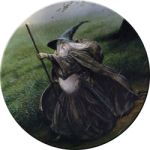
Gandalf (© John Howe)


‘The important thing is not to stop questioning.’ —Albert Einstein